
Reviewed · SELF-GUIDED TOURS
Explore Copenhagen: Self-Guided Audio Tour
Copenhagen’s grandest sights fit into one practical walking route, from the gilded Bishop Absalon above City Hall to the royal kitchens beneath Christiansborg Palace. The self-guided format gives you control over your pace, while the audio files provide directions between stops instead of leaving you to follow a blinking GPS dot.
I like two things here: the route links major sights rather than isolated monuments, and the included map and spoken directions help you move from one stop to the next. The price, $15.29, is also modest for two to three hours of city orientation. The main drawback is uneven audio quality. One report describes muffled background sounds, static at higher volume, and a narrator who sounds more like he is reading than telling a story.
- A route through seven major sights: City Hall, the Round Tower, Rosenborg Castle, Marble Church, Amalienborg, the Royal Danish Theatre, and Christiansborg’s royal kitchens.
- The Round Tower uses a spiral ramp: This unusual 17th-century observatory has no standard staircase leading to the top.
- Useful downloadable material: You receive audio files, a GPS map, and directions, but you must download the files before setting out.
- No entrance tickets are included: You can follow the route without entering each attraction, or pay separately where admission is available.
- Flexible start and finish: The listed start is City Hall Square and the listed end is Tivoli Gardens, but you control both points.
- English only and self-paced: There is no physical guide, no supplied audio device, and no scheduled group departure.
Seven Copenhagen sights in one compact walk
This tour is best understood as a city walk with an audio guide attached. It is not a museum pass, a guided group outing, or a transport service. You walk from central Copenhagen’s City Hall Square toward royal Copenhagen, listening to short commentary and directions at each stop.
The planned visit gives roughly 15 minutes to each location. That is enough to look, listen, take photographs, and understand the basic story. It is not enough for a full interior visit at every attraction. If you enter the Round Tower, Rosenborg Castle, Marble Church, or another site, allow extra time and pay the admission fee separately.
The audio package contains 13 files, along with a map and other downloaded material. That is more than the seven named stops, so prepare the files before you leave your hotel or apartment. You do not want to be standing in City Hall Square trying to unzip a file, find the correct track, and sort out your phone’s volume settings.
City Hall Square and Bishop Absalon
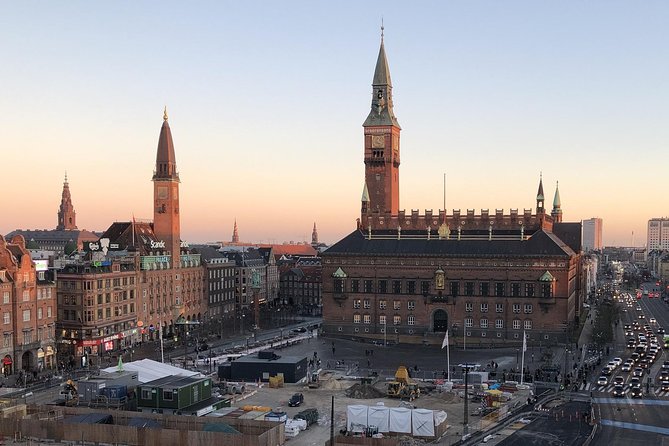
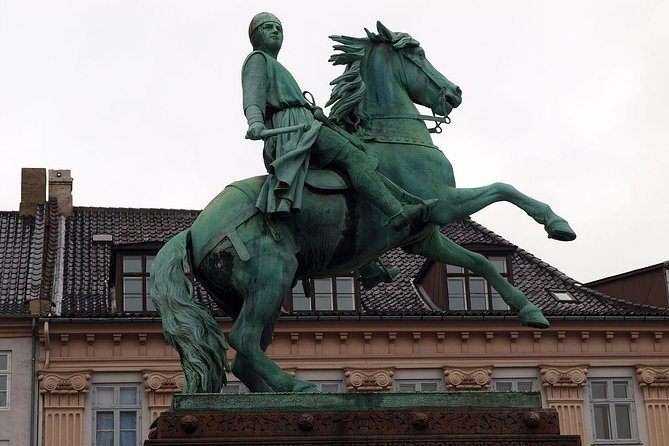
Begin at Rådhuspladsen, Copenhagen’s largest square. City Hall is easy to recognize, with its ornate brick facade, clock tower, and gilded statue of Bishop Absalon above the front balcony.
The building reflects Denmark’s National Romantic style, as imagined by architect Martin Nyrop. Its design takes inspiration from Siena’s City Hall, giving this first stop a useful point of comparison with Italian civic architecture.
The suggested 15 minutes works well for an exterior look and the opening audio. You can pause to study the brickwork and the square’s scale before moving on. Entrance is not included, so the route treats City Hall mainly as a starting landmark.
This is a sensible opening stop because the square is prominent and easy to locate. It also gives you an immediate sense of Copenhagen as a capital shaped by both civic government and monarchy.
A few more Copenhagen trips to weigh up
- Copenhagen Little Mermaid Exploration Game and Self-Guided Tour
★ 4.0 · 36 reviews - Half Day Self-Guided Audio Walking Private Tour in Copenhagen
★ 5.0 · 21 reviews - Monstour: A Self-Guided Audio Tour of Danish Folk Legends
★ 4.5 · 19 reviews
The Round Tower and its ramp to the sky
The Round Tower is one of the route’s most unusual buildings. Constructed in the 17th century, it served as an astronomical observatory and formed part of the Trinitatis Complex, together with Trinitatis Church and an academic library connected to Copenhagen University.
That library opened in 1657 and once held about 10,000 books, the university’s entire collection at the time. The detail helps explain how much work and learning once gathered in this small part of the city.
The building’s most memorable feature is its interior ramp. Instead of climbing a conventional staircase, you follow a spiral path toward the top. That design makes the tower particularly interesting for visitors who enjoy architecture and practical engineering.
The tour allows 15 minutes here, which is enough for a look at the exterior and an introduction to the building. It may feel short if you plan to pay for admission and go inside. Since the ticket does not cover entry, decide in advance if you want to add that cost and time.
Rosenborg Castle and Christian IV’s Copenhagen
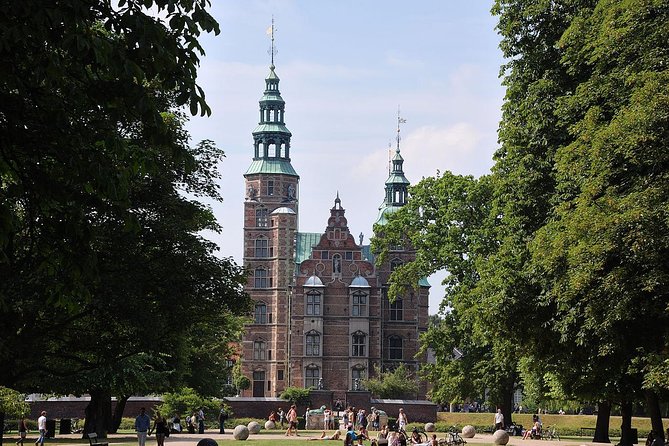
Rosenborg Castle brings you into the world of King Christian IV, who commissioned many major building projects in Copenhagen. The castle’s Dutch Renaissance design is easy to spot, with high gables and spires giving it a storybook profile.
Construction did not stop after the first stage. The building continued to expand until it reached its present form in 1624. That slow growth is useful context when you look at the castle as more than a single royal residence. Its final appearance reflects several stages of royal ambition and planning.
A 15-minute stop is enough for an outside view and a short history lesson. It is not a substitute for an interior visit. If you want to see the royal collections housed inside, you will need a separate admission and more time than this walking schedule allows.
I like the placement of Rosenborg in the route because it gives the audio walk a strong architectural change after the civic buildings and observatory. You move from public Copenhagen into the city’s royal past without needing a coach or a fixed group timetable.
Marble Church and the Frederiksstaden plan
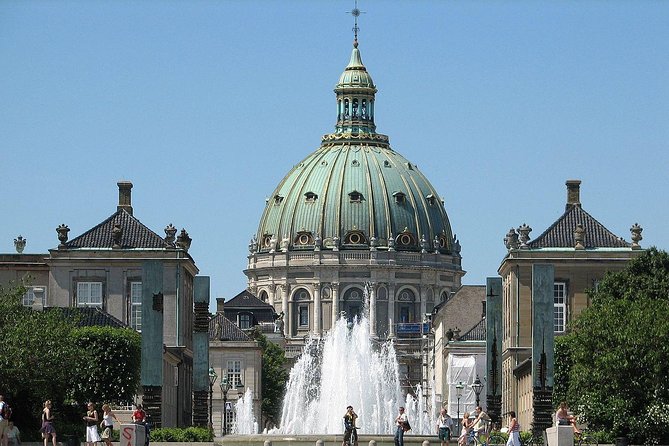
Frederiks Kirke is better known as Marble Church, and its huge dome is the key feature. It is the largest church dome in Scandinavia, according to the tour information, and the scale becomes clear even during a brief exterior stop.
The church’s official name honors King Frederik V. In 1748, he began planning Frederiksstaden, a grand district intended to reshape this part of Copenhagen. The church was part of that larger royal vision.
The 15-minute timing lets you hear the background and take in the building without turning the stop into a long church visit. Admission is not included. If you want to go inside, check how that affects your walking schedule, since the route continues to Amalienborg and the Royal Danish Theatre.
This stop adds an important planning lesson. Copenhagen’s royal buildings are not scattered by chance. Marble Church belongs to a district designed as a formal expression of royal power, and the next stop makes that point even clearer.
Same city, a completely different kind of day:
- Copenhagen Card-Discover: 80+ Attractions & Public Transport
★ 4.6 · 5,351 reviews - Copenhagen: Hop-On Hop-Off Bus Tour with Boat Tour Option
★ 3.9 · 4,122 reviews - Private Walking Grand Tour of Copenhagen
★ 5.0 · 3,953 reviews - From Copenhagen: Lund and Malmö 2-Country Tour
★ 4.7 · 3,807 reviews
Amalienborg and the modern Danish royal family
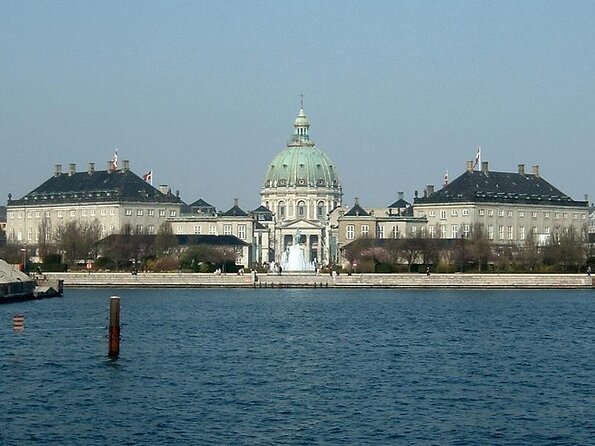
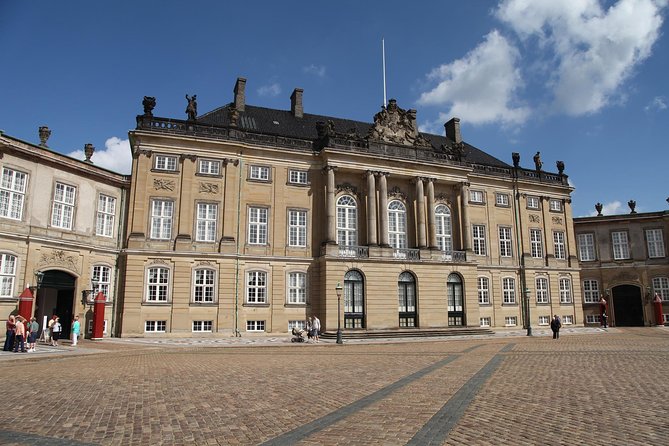
Amalienborg Palace is the current home of the Danish royal family. The complex began with a palace built from 1669 to 1673 for Queen Sophie Amalie, wife of King Frederik III.
The palace you see today took shape under Frederik V. He dismantled the earlier palace and created the octagonal complex that now defines Amalienborg. The result was intended as the crowning feature of Frederiksstaden.
The audio stop is valuable because it connects the palace to the Marble Church and the surrounding district. Rather than treating Amalienborg as a lone royal building, you learn how the palace was meant to complete a carefully planned quarter.
Again, 15 minutes is a quick visit. You can look across the complex, listen, and take photographs, but the ticket does not include entry. This is one of the places where the self-guided format helps: you can linger outside if you wish, or continue promptly if your priority is covering the entire route.
The Royal Danish Theatre Play House
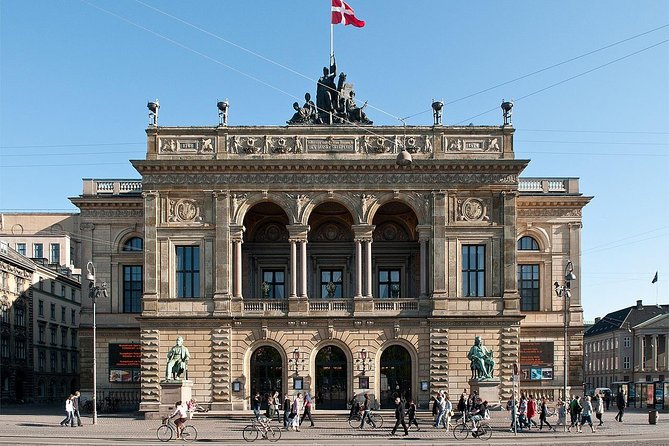
The Royal Danish Theatre adds performing arts to the route’s mix of government, architecture, religion, and monarchy. The first theatre on this site opened in 1748. It seated 800 people and employed eight actors and four actresses, with French comedies making up much of the program.
That original building soon proved too small for Copenhagen. It was rebuilt in 1774 to accommodate a larger audience, and the Royal Danish Theatre became a home for ballet, opera, and the royal orchestra.
The stop lasts about 15 minutes, giving you a quick look and the institutional story behind the building. It is a reminder that royal Copenhagen was not only about palaces. Music, theatre, ballet, and public performance also played a part in the city’s cultural life.
You should not expect a performance or theatre admission as part of this experience. The attraction is the exterior context and the audio explanation. If you are especially interested in the performing arts, the short stop may leave you wanting a separate visit.
Christiansborg’s royal kitchens and layers of power
The final major stop is the Royal Kitchens of Christiansborg Palace. Christiansborg has been built over the remains of four earlier castles, making this one of the route’s strongest history lessons.
Bishop Absalon constructed the first castle on the island in 1167. It lasted more than 200 years before the Hanseatic League destroyed it. Copenhagen Castle then rose over the ruins and remained for several centuries.
The site is also linked with the Blue Tower, where Leonora Christina, daughter of Christian IV, was held captive for nearly 22 years. That detail gives the palace grounds a human story alongside the broader account of castles, royal authority, and destruction.
The tour names the royal kitchens as the stop, but admission is not included. You receive the historical setting through the audio rather than a guaranteed interior visit. Allow extra time and budget if you want to enter.
The route is listed as ending at Tivoli Gardens on Vesterbrogade. Since the experience is self-guided, you can adjust the ending to suit your plans. You might stop the audio at Christiansborg, continue toward Tivoli, or finish somewhere else according to your schedule.
What the audio package does well
The strongest practical feature is that the route does not depend entirely on an automatic GPS signal. The downloaded material includes a map and spoken directions to the destinations. That matters in a dense city, where a phone can point you vaguely in the right direction without explaining which street or square to use.
The directions are especially useful for a self-guided walk because you have no guide to gather the group or correct a wrong turn. You still need to pay attention to the map and your surroundings, but the experience gives you more help than a simple list of GPS pins.
The files also let you set your own rhythm. Pause the audio for photographs, stop for food, or skip a location without holding up anyone else. There is no physical audio device, so your own smartphone must do the work.
Where the audio experience falls short
Sound quality is the main concern. Background effects can muffle the speaker, and one report describes static when the volume is raised. That is more than a minor annoyance, since the entire product depends on clear listening.
The narrator’s delivery may also feel flat. The content is described as strong and informative, but the voice can sound as if it is reading a script rather than bringing the material to life. You may care less about this if you mainly want directions and concise facts. If storytelling is the reason you book an audio tour, keep the limitation in mind.
Download everything before starting, then test the files with your phone and headphones. This is the most useful preparation you can make. If your phone speaker is weak, headphones may help, though the supplied information does not promise a particular audio setup.
Is $15.29 a fair price?
At $15.29 per person, this is a low-cost way to get an organized introduction to central Copenhagen. You receive audio files, a map, and a route covering seven significant places. For a first afternoon in the city, that can be good value.
The price looks less attractive if you expect entry to the attractions. No admission fees, transportation, food, drinks, or audio device are included. You also do not receive a physical guide. Add those costs only if you decide to enter the sites, but remember that the listed price covers the walking commentary, not a full sightseeing package.
The value depends on how much independence you want. A private guide would provide conversation and immediate answers, but this option is far cheaper and lets you stop whenever you like. The tradeoff is that you must manage the downloads, navigation, timing, and any admission purchases yourself.
Who should choose this walk?
I would recommend it to independent visitors who want a clear route and basic historical context without joining a scheduled group. It suits people comfortable using a smartphone and adjusting plans as they go.
It is also a good fit if you want to see the outside of several central sights in one outing. The mix is broad: civic architecture, an observatory, a Renaissance castle, a domed church, a royal palace, a theatre, and a palace site built over earlier castles.
You may want another option if you need polished sound, lively narration, or a guide who can answer questions. The audio limitations matter more when listening is your main reason for booking. The route also requires moderate physical fitness, and transport is not provided.
The experience is offered only in English. Confirmation arrives at booking, and service animals are allowed. The activity can have up to 50 people associated with it, but because it is self-guided, you are not joining a conventional group with a tour leader.
My booking advice
Book this if you value a low price and flexible walking plan more than personal guiding or guaranteed audio polish. Prepare the files in advance, carry your own phone, and treat the 15-minute stops as introductions rather than complete attraction visits.
Skip it if you want admission bundled into the price, a live explanation, or a carefully produced sound experience. For the right user, though, the route gives you a useful framework for seeing Copenhagen’s central royal quarter on your own terms.
FAQ
How long does the Copenhagen audio tour take?
The experience takes approximately two to three hours. The planned time is about 15 minutes at each of the seven listed stops.
What language is the tour offered in?
The tour is available only in English.
Where does the tour start?
The listed starting point is Rådhuspladsen, 1599 Copenhagen, Denmark, at City Hall Square.
Where does the tour end?
The listed ending point is Tivoli Gardens at Vesterbrogade 3, 1630 København V, Denmark. Because the experience is self-guided, you decide your actual starting and ending points according to your schedule.
Is a physical guide included?
No. This is a self-guided audio tour, so there is no physical guide.
Do I receive an audio device?
No. An audio device is not included. You use your own smartphone after downloading the audio files.
What is included in the price?
The price includes audio files and a GPS map. The tour is self-paced.
Are attraction admission fees included?
No. Admission fees are not included. The listed stops include City Hall, the Round Tower, Rosenborg Castle, Marble Church, Amalienborg, the Royal Danish Theatre Play House, and the Royal Kitchens of Christiansborg Palace.
Do I need to download anything before starting?
Yes. Download the audio file and have it ready before you begin. The downloading instructions appear in the Before You Go section of your ticket, and the package includes a zip file with 13 audio files, a map, and other files.
Can I cancel the booking?
Yes. You can cancel for a full refund if you cancel at least 24 hours before the experience start time. Changes or cancellations made less than 24 hours in advance are not accepted for a refund.
Just added around Copenhagen
- Urban Design and Livability E-bike Tour★ 4.8 · 21 reviews
- Full-Day Tour; Castle, Palace & Cathedral, Winter(JAN-MAR)★ 5.0 · 11 reviews
- a day at North Zealand Castle Tour★ 4.5 · 19 reviews
- Copenhagen Walking Tour with Food Testing (smorrebrod dish & snap)★ 4.5 · 10 reviews
- The Philosopher’s Last Walk: An audio tour on the life of Søren Kierkegaard★ 4.5 · 5 reviews
- The Six Forgotten Giants Trolls Hunt with Minibus★ 4.5 · 27 reviews
- The Forgotten Giants Private Tour★ 5.0 · 3 reviews
- Explore the Instaworthy Spots of Copenhagen with a Local★ 3.5 · 3 reviews
Self-Guided Tours, compared.
The Ancient Viking Stronghold of Aros: A Self-Guided Audio Tour in Aarhus
Read our review →
Copenhagen Little Mermaid Exploration Game and Self-Guided Tour
Read our review →
Half Day Self-Guided Audio Walking Private Tour in Copenhagen
Read our review →
Monstour: A Self-Guided Audio Tour of Danish Folk Legends
Read our review →
Copenhagen Self-Guided Murder Mystery Tour by the Round Tower
Read our review →
Copenhagen Christiania: Hidden Stories Self-Guided Adventure
Read our review →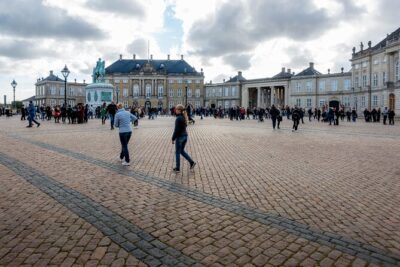
Copenhagen Royal Conspiracy Exploration Game and Tour
Read our review →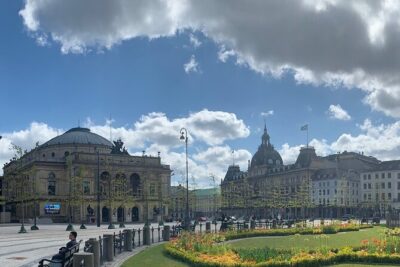
Copenhagen’s Royal History: A Self-Guided Walking Tour
Read our review →Browse the lists this tour appears in