
Reviewed · 2-HOUR EXPERIENCES
Copenhagen (2-Hour Paper Marbling Workshop with Goda)
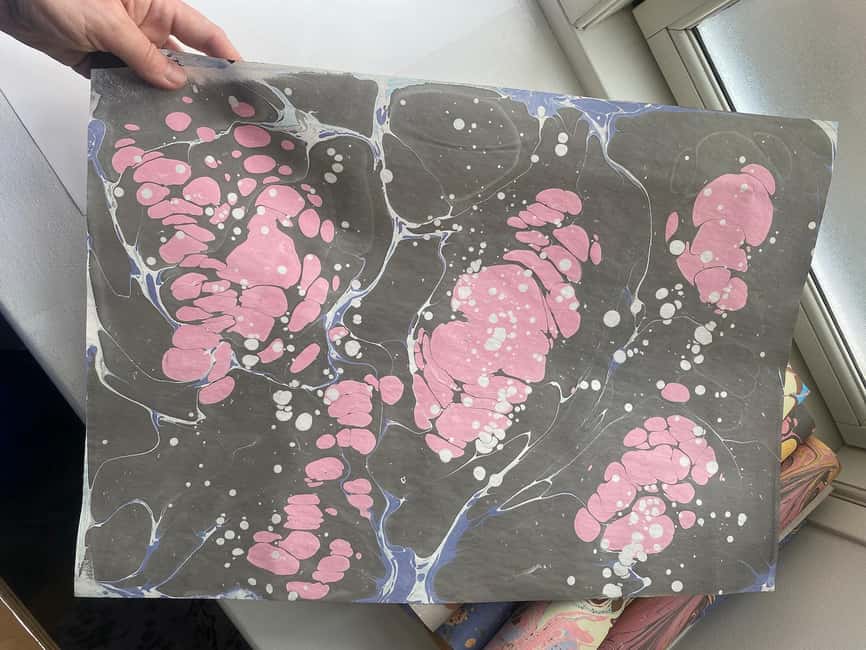
Paper marbling turns a shallow bath of thickened water into a tiny art studio. You drop paint onto the floating surface, move it with traditional tools, lay paper over the top, and lift a one-of-a-kind pattern. I like the small groups of no more than three and the chance to learn directly from designer and traveler Goda. I also like that you make several prints, not just one token souvenir.
The main consideration is timing. Your papers need to dry before you pack them, and drying or delivery is not guaranteed as a standard service. If you leave Copenhagen soon, book at least a day or two ahead and ask Goda about the best way to collect your work.
Key points at a glance
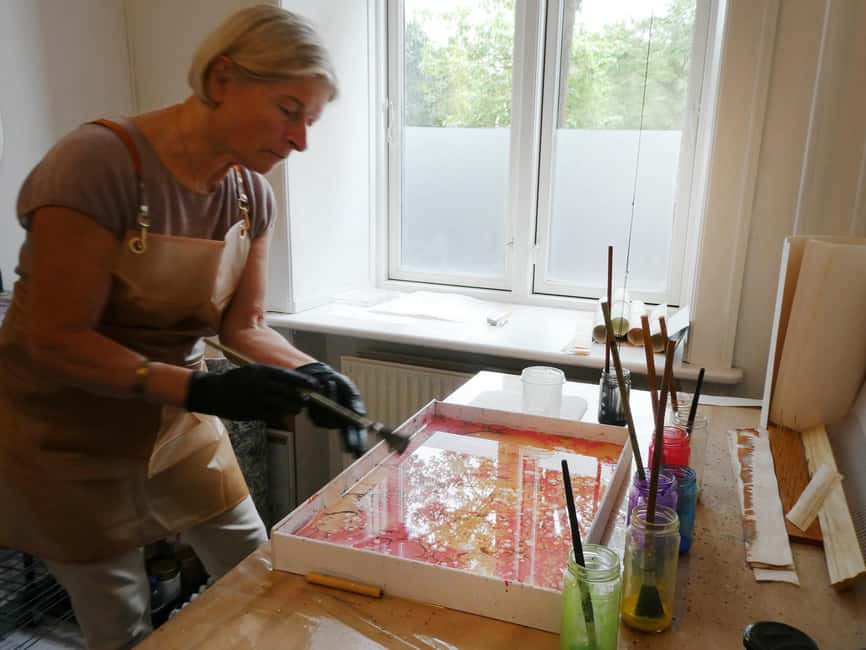
- Ancient printmaking with modern appeal: Learn a craft practiced in Japan about 1,000 years ago before it traveled west through Persia, Turkey, and Europe.
- A genuinely small workshop: Sessions are limited to three people, making this a calm choice for a pair, a parent and child, or a solo participant.
- Several handmade souvenirs: Create your own marbled sheets and take the prints home rather than buying a mass-produced keepsake.
- Held at BLADR in Nørrebro: The workshop takes place inside an artist bookstore at Griffenfeldsgade 27.
- Everything is prepared for you: Pre-mixed colors, pre-cut paper, an apron, and a ready carrageenan bath are included.
- Plan around drying time: Tea and coffee are served while the papers dry, but sending prints is not included.
Why this two-and-a-half-hour Copenhagen workshop is different
Copenhagen offers plenty of museums, churches, and design shops. This activity gives you something different: a chance to make an object rather than simply look at one.
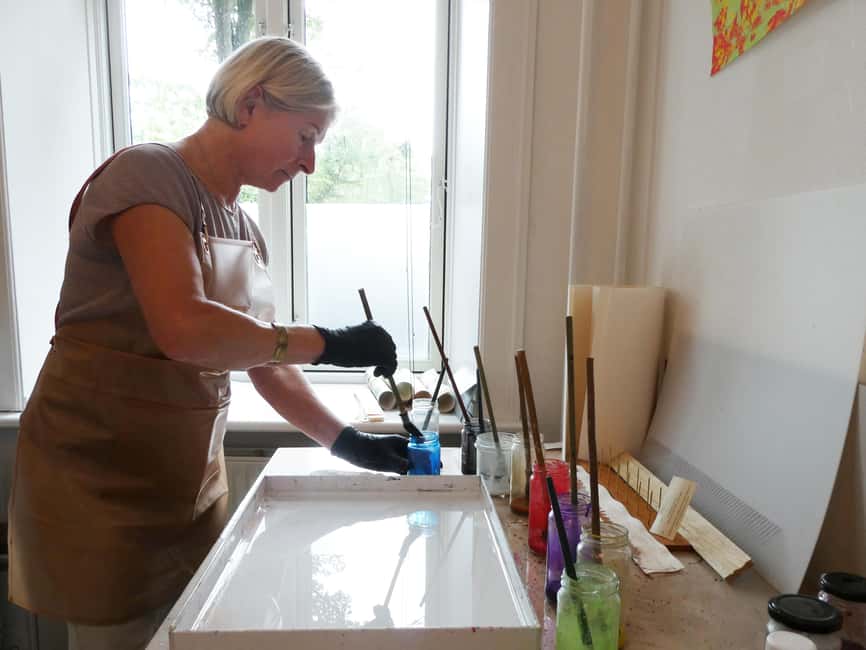
Paper marbling is a printmaking method built around controlled chance. The paint sits on a floating liquid surface called size, which is prepared here with water and carrageenan powder. You shape the colors, but the final pattern still contains surprises. That balance makes the craft approachable. You do not need to arrive with drawing skills or an art-school background.
The method has a long route behind it. It was practiced in Japan roughly 1,000 years ago, then spread to Persia and Turkey. Travelers later carried it into Europe, where marbled paper found practical uses in precious documents, album covers, book endpapers, and furniture decoration.
That background adds meaning without turning the session into a lecture. You are learning a working craft that has been used to make ordinary objects feel special. The paper you produce may be small, but it carries the marks of your hands and the unpredictable movement of paint.
A few more Copenhagen trips to weigh up
- Copenhagen Photography Masterclass – Private Photography Lesson
★ 5.0 · 5 reviews - Private Photography Workshop in Copenhagen
★ 5.0 · 3 reviews
Inside BLADR on Griffenfeldsgade 27
The workshop takes place at BLADR, an artist bookstore in Nørrebro. That setting fits the activity well. You are not being taken to a large production room or a general-purpose classroom. You enter a creative space where paper, books, and design already belong.
The atmosphere is private and relaxed. A group of two or three works especially well, though single participants are welcome. For couples and friends, the small size means you can focus on your own work while still sharing the experience. For a parent and child, it offers a hands-on activity with a clear result to take home.
Goda runs the workshop herself. She is described as both a designer and a traveler, a useful combination for a creative session aimed at people visiting from abroad. Instruction is available in English and Danish, so English-speaking visitors can take part without needing to know Danish.
You will want to arrive ready to work with wet paint. An apron is included, and the colors, papers, and marbling bath are prepared in advance. That preparation matters. You spend your 150 minutes learning and printing instead of measuring powders or waiting for supplies to be mixed.
How the 150 minutes unfold
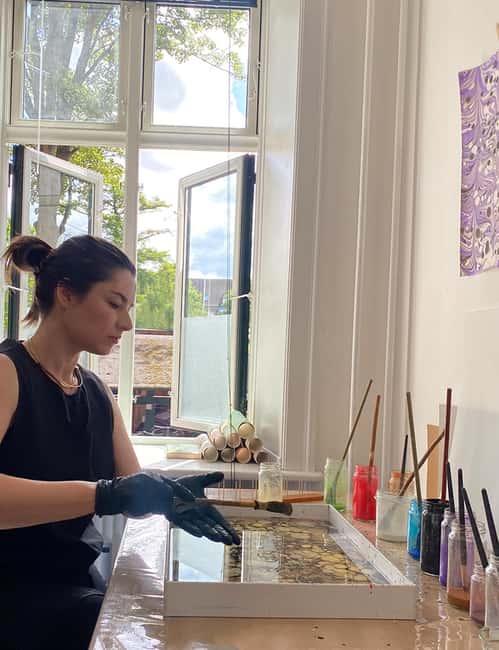
The session begins with an introduction to the technique and its basic tools. You learn how the floating surface works, how paint behaves on it, and how traditional gestures create different movements in the colors.
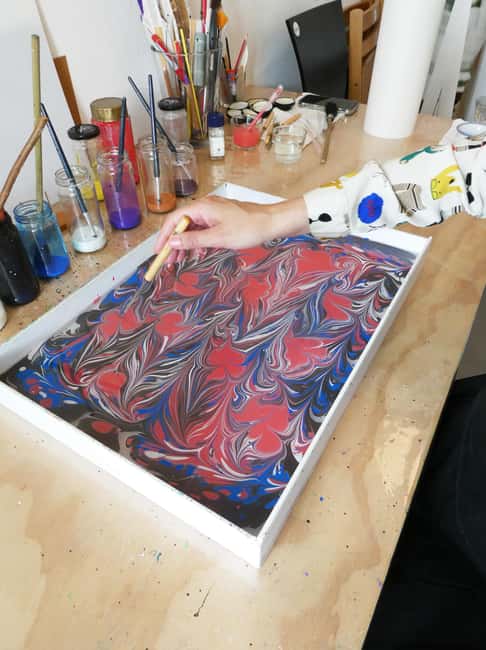
This is the part where the craft starts to make sense. A brushstroke does not behave on the size as it would on ordinary paper. Color spreads, floats, and shifts. Small changes in movement can produce a different pattern, so you learn by watching closely and trying things yourself.
Next comes the color work. The colors are pre-mixed, which keeps the session practical and leaves more time for making prints. You learn how different shades interact, and how the order and placement of paint affect the final image.
Then you begin creating your own designs. Traditional tools and hand movements can produce different effects, from flowing lines to more structured patterns. You place a sheet of paper onto the floating surface, allow the image to transfer, and lift it away to reveal the print.
That reveal is the small thrill at the heart of the activity. You can guide the process, but you cannot fully predict the result. Two sheets made from similar colors will not be identical. Each print is a fresh arrangement, and minor variations are part of the point rather than mistakes.
You should have time to make several pieces. The exact number will depend on your pace and the working process, but the experience is designed around creating your own prints rather than watching Goda demonstrate and then leaving with one sample.
The satisfying appeal of controlled chance
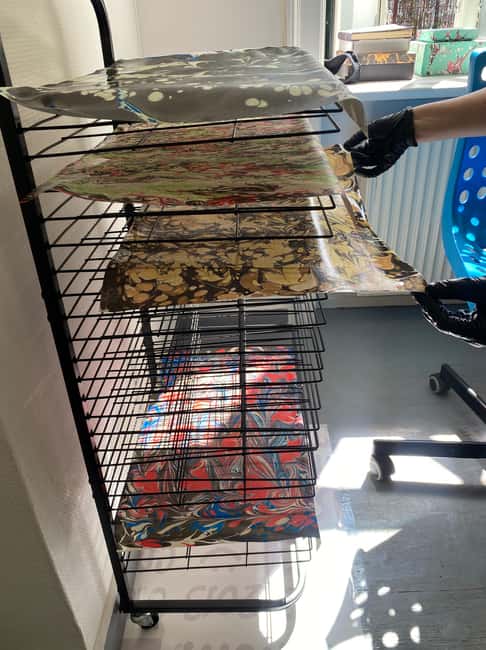
Some craft workshops can feel like a long demonstration followed by a rushed attempt. This one is more appealing because the central action is simple: arrange paint, place paper, lift the sheet, and see what happened.
The process also has a calm rhythm. You make a pattern, transfer it, inspect the result, and try again with a new combination. Susan described the activity as calming and almost meditative, which makes sense given the slow attention the technique requires.
That quiet pace can be a welcome change after a day of sightseeing. You are still doing something active, but the focus shifts from navigating streets and checking opening hours to watching paint move across water.
There is room for happy accidents. A pattern that does not match your first plan may turn into your favorite print. The craft rewards curiosity more than perfection, making it suitable for children old enough to follow instructions, adults who enjoy design, and people who insist they are not artistic.
Same city, a completely different kind of day:
- Copenhagen Card-Discover: 80+ Attractions & Public Transport
★ 4.6 · 5,351 reviews - Copenhagen: Hop-On Hop-Off Bus Tour with Boat Tour Option
★ 3.9 · 4,122 reviews - Private Walking Grand Tour of Copenhagen
★ 5.0 · 3,953 reviews - From Copenhagen: Lund and Malmö 2-Country Tour
★ 4.7 · 3,807 reviews
What you take home, and when
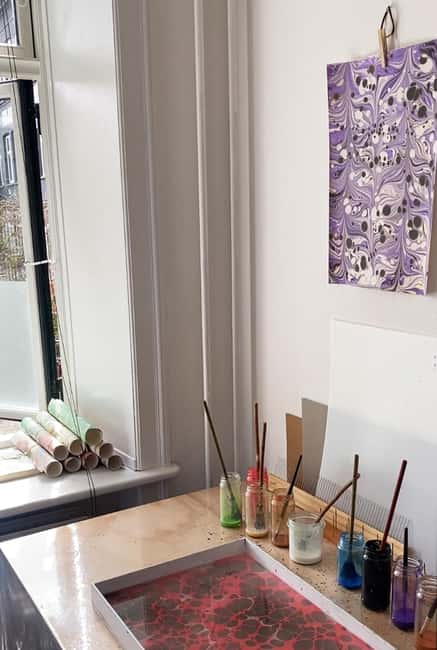
The biggest practical benefit is the souvenir. You are not simply buying a sheet of marbled paper from a shop. You are taking home pieces made during your time in Copenhagen.
The prints can be framed, used in albums, or kept as reminders of the trip. Their handmade quality also makes them more personal than a standard city souvenir. No two sheets come out exactly alike, so your set will record your own choices and the chance movements of the paint.
Drying is the key issue. The papers need time before they can be packed safely. Tea and coffee are served while the prints are drying, giving the session a pleasant final pause, but you should not assume the paper will be ready to carry away immediately.
One participant had a particularly helpful arrangement: Goda dried and ironed the papers, packaged them for travel, and delivered them to a hotel. In another case, she went out of her way to deliver dried prints in snowy weather because the participant was leaving the next day. These are thoughtful examples, but sending prints is not included in the listed activity, so you should discuss your departure plans with Goda before booking.
The safest plan is to schedule the workshop at least one or two days before you leave Copenhagen. That gives the paper time to dry and gives you a better chance of arranging collection. If you book at the end of your trip, ask directly about drying and delivery rather than assuming your prints will be ready on demand.
Is $110 a fair price?
At $110 per person, this is not a budget activity. You are paying more than you would for a museum visit or a casual craft kit. The value comes from the private format, personal instruction, prepared materials, and the number of handmade prints you can create.
A large class could offer a cheaper seat, but it would not provide the same quiet attention. Here, the group limit of three gives Goda room to explain the tools, watch your technique, and help you adjust your movements.
The price also covers more than paint and paper. It includes pre-cut sheets, pre-mixed colors, the prepared carrageenan bath, an apron, and tea and coffee. That means you avoid buying supplies, preparing the size, and figuring out how to transport wet artwork on your own.
I would consider it good value if you already enjoy design, books, printmaking, or handmade objects. It is also a sensible splurge for a special parent-child outing or a creative date in Copenhagen. If you only want a quick souvenir or are watching every dollar, the price may feel high for a two-and-a-half-hour activity.
The strong rating, with three five-star scores, supports the idea that the workshop delivers a warm and memorable experience. Still, the most useful value question is personal: do you want to spend part of your Copenhagen visit making something, or would you rather use those hours to see another sight?
Who will enjoy the session most
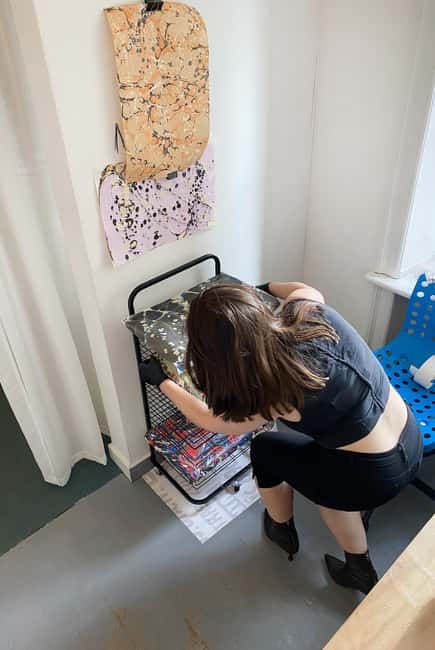
I would recommend this for art lovers, design fans, stationery enthusiasts, and anyone who likes trying something unusual in a city. You do not need previous printmaking experience. The process is explained through the materials and gestures, and the unpredictable result removes some pressure to get everything perfect.
Families can also make good use of the small format. A mother and daughter created prints together and left with several pieces connected to their Copenhagen trip. The private setting gives you a chance to share the activity rather than simply supervise from the side.
Solo participants are welcome, too. A small class can be easier for a solo visitor than a large social workshop because you can work at your own pace and receive direct guidance.
This is less suitable if you need a fast stop between major attractions. The session lasts 150 minutes, and the work may need additional drying time. It is also not the right pick if you want a guided tour of Nørrebro or a broad art lesson. The focus stays on paper marbling inside BLADR.
Practical details that affect your choice
The workshop is held at Griffenfeldsgade 27, inside BLADR in Nørrebro. Check the exact starting time when you book, since the activity lasts about two hours to two and a half hours depending on the stated schedule.
All core materials are supplied. That includes the pre-mixed colors, pre-cut paper, prepared carrageenan bath, and apron. Tea and coffee are included, and a small snack has also been provided during at least one session, though you should treat the snack as a courtesy rather than a guaranteed inclusion.
Instruction is available in English and Danish. The group is limited to three participants, and single individuals can reserve a place.
Cancellation is flexible up to 24 hours before the activity for a full refund. You can also reserve now and pay later, which helps if your Copenhagen plans are still shifting. Sending the completed prints is not included, so allow time and budget for that only if you choose to arrange it.
My verdict: book it if you want a personal souvenir
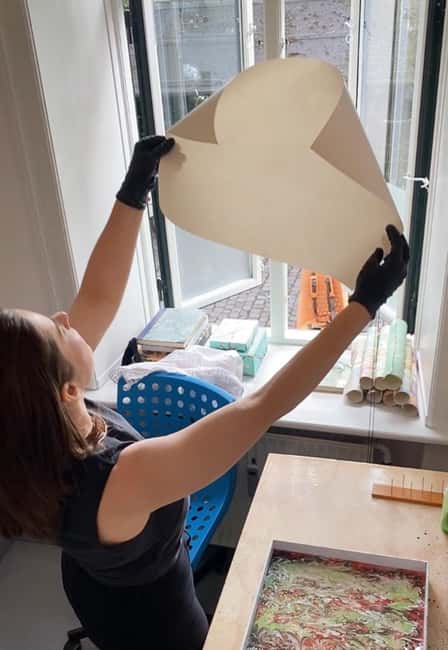
I would book this workshop if you want a peaceful, hands-on Copenhagen experience with a real object to show for your time. Goda’s small-group format, careful preparation, and willingness to help with drying and delivery make the activity especially appealing for visitors who value personal attention.
Book it early enough for the papers to dry, especially if you leave the next morning. If you are seeking the lowest-cost activity or prefer sightseeing that covers several places, spend your $110 elsewhere. But if making several unpredictable, beautiful prints sounds more rewarding than another hour indoors with a camera, this is a smart creative choice.
FAQ
Where does the paper marbling workshop take place?
It takes place inside the artist bookstore BLADR at Griffenfeldsgade 27 in Nørrebro, Copenhagen.
How long does the workshop last?
The stated duration is 150 minutes, or about two and a half hours.
Who leads the workshop?
The workshop is run by Goda, a designer and traveler.
What languages are available?
Instruction is available in English and Danish.
How many people can join?
The workshop is limited to three participants. Single individuals and small groups of two or three are welcome.
Are materials included?
Yes. The activity includes pre-mixed colors, pre-cut paper, a prepared carrageenan bath, and an apron.
Can I take my prints home?
Yes. You can make your own marbled prints and take them home, but the papers need to dry first.
Are tea and coffee included?
Yes. Tea and coffee are served while the papers are drying.
Is sending the prints included?
No. Sending the prints is not included.
How late can I cancel for a full refund?
You can cancel up to 24 hours in advance for a full refund.
Just added around Copenhagen
- Urban Design and Livability E-bike Tour★ 4.8 · 21 reviews
- Full-Day Tour; Castle, Palace & Cathedral, Winter(JAN-MAR)★ 5.0 · 11 reviews
- a day at North Zealand Castle Tour★ 4.5 · 19 reviews
- Copenhagen Walking Tour with Food Testing (smorrebrod dish & snap)★ 4.5 · 10 reviews
- The Philosopher’s Last Walk: An audio tour on the life of Søren Kierkegaard★ 4.5 · 5 reviews
- The Six Forgotten Giants Trolls Hunt with Minibus★ 4.5 · 27 reviews
- The Forgotten Giants Private Tour★ 5.0 · 3 reviews
- Explore the Instaworthy Spots of Copenhagen with a Local★ 3.5 · 3 reviews
2-Hour Experiences, compared.
Group Walking Tour – City Highlights – 2 Hours
Read our review →
Segway Tours Copenhagen w. Guide & Concierge Service. 2 Hours+
Read our review →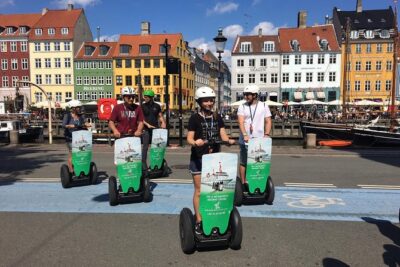
2-Hour Walking Introduction to Copenhagen and its Main Sights
Read our review →Browse the lists this tour appears in