
Reviewed · COPENHAGEN TOURS
Explore Copenhagen’s Art and Culture with a Local
Copenhagen’s art and culture are spread across its streets, squares, gardens, and harbor, and this 90-minute walking tour gives you a quick first look at many of them. You’ll begin at Stork Fountain and finish in Nyhavn, passing street art, royal sights, a historic fortress, and the Marble Church along the way.
I like the small group limit of eight, which should make it easier to ask questions and keep up with the guide. I also like the local angle: the tour includes Danish food customs, neighborhood street art, and city stories that you may not get from simply walking between the major sights.
The main drawback is the short running time. You cover a lot of ground in an hour and a half, so the commentary may feel more like a lively introduction than a detailed art or history lesson. There can also be quiet stretches, and the route does not promise interior visits to museums, galleries, or palaces.
Key points to know before you book
- Stork Fountain to Nyhavn: The route crosses several of Copenhagen’s best-known central sights in one compact walk.
- Street art with a local angle: You’ll see work by Stine Hvid and hear about other examples in different parts of the city.
- A small group of no more than eight: This is more personal than a large city walk and suits travelers who like to ask questions.
- Royal Copenhagen in one outing: The route includes a historic castle and gardens, a palace square, the Marble Church, and a view of the Royal Opera House.
- A fast orientation, not a museum tour: You’ll learn about art, architecture, history, and food customs, but the tour does not include food, drinks, or admission to attractions.
- A central finish at Nyhavn: The colorful 17th-century harbor makes an easy place to continue sightseeing after the guide says goodbye.
What this Copenhagen walk is really designed to do
This experience works best as an introduction to Copenhagen, especially during your first day in the city. It links sights that can otherwise seem scattered, giving you a sense of how the old town, royal quarter, fortress area, and waterfront fit together.
You are not signing up for a long museum visit or a specialist lecture. The guide’s job is to point out what matters, explain the stories behind it, and help you notice details you might pass without a second glance. That makes the walk useful for a new arrival, but it can also suit a returning visitor who wants a fresh look at familiar streets.
The experience is offered in English and lasts about one hour and 30 minutes. At $128.94 per person, it is not a bargain city stroll. Its value depends on what you want from a guide. If you appreciate a private-feeling small group and direct access to a local, the price may make sense. If you mainly want a list of landmarks and photographs, you can see much of this central area on your own for far less.
Group discounts may improve the cost for people booking together. Since personal expenses, food, drinks, and snacks are not included, you should treat the price as payment for the guided walk only.
Other Copenhagen days people book alongside this one:
- Copenhagen Card-Discover: 80+ Attractions & Public Transport
★ 4.6 · 5,351 reviews - Copenhagen: Hop-On Hop-Off Bus Tour with Boat Tour Option
★ 3.9 · 4,122 reviews - Private Walking Grand Tour of Copenhagen
★ 5.0 · 3,953 reviews
Starting at Stork Fountain and Amagertorv
The meeting point is Stork Fountain at Amagertorv 6, in central Copenhagen. This is a strong place to begin because the setting immediately gives you the feel of the old town: a historic square, a mosaic floor, and elegant buildings around it.
The fountain is more than a simple marker for the group. It gives the guide a natural starting point for explaining Copenhagen’s central streets and public spaces. You’ll want to arrive ready to walk, since this is an outdoor sightseeing experience rather than a seated introduction.
The opening stop also helps set the pace. The guide can point out the relationship between the square, nearby buildings, and the route ahead. If you are still learning your way around Copenhagen, that early orientation can be useful later when you explore independently.
Because the walk is short, do not expect a long stop here. Think of Stork Fountain as the first chapter, not the main event.
Stine Hvid’s street art and the city beyond the postcard
One of the more distinctive parts of the walk is a stop to view street art by Stine Hvid. This adds a modern note to a route otherwise filled with fountains, castles, churches, palaces, and old harbor buildings.
I like this contrast. Copenhagen can easily be reduced to royal architecture and colorful waterfront photographs, but public art shows another side of the city. The guide also talks about other impressive examples in different neighborhoods, so you get a wider sense of Copenhagen’s street-art scene even though this tour does not visit every area where that work appears.
Keep your expectations realistic. The experience provides commentary about art, museums, and galleries, but it does not promise entry into a gallery or a full street-art tour. You might hear about places that would be worth visiting later, rather than seeing them all during this compact route.
This is also one place where the guide’s personal knowledge matters. A local can explain what to notice in a piece, point out how public art fits into the city, and suggest areas for your own follow-up walk. The exact depth will depend on the individual guide and the questions your group asks.
A castle, gardens, and Hans Christian Andersen

The next section brings you to a historical castle and its gardens, where you’ll see a sculpture of Hans Christian Andersen. This stop gives the walk a quieter pause after the city-center streets and street art.
The sculpture is a useful reminder that Copenhagen’s cultural identity is not limited to buildings and paintings. Andersen is one of Denmark’s best-known cultural figures, and placing his sculpture in a garden setting gives the guide a chance to connect literature, public memory, and the city’s royal surroundings.
The word historical covers a lot here, and the provided details do not identify the castle by name or promise access inside. You should therefore expect an exterior view and garden surroundings rather than a castle tour. That distinction matters if you are hoping to see rooms, collections, or formal interiors.
Still, this stop should appeal to you if you enjoy seeing how Copenhagen uses open spaces and monuments to tell stories. It is also a good point to slow down, take photographs, and listen for the local details that a self-guided route might skip.
Same city, a completely different kind of day:
- From Copenhagen: Lund and Malmö 2-Country Tour
★ 4.7 · 3,807 reviews - Copenhagen Highlights Walking Tour
★ 5.0 · 2,324 reviews - Copenhagen: Highlights 3 Hour Bike Tour with a Local Guide
★ 4.8 · 2,312 reviews - Hamlet and Sweden Tour – Two Countries in one day !
★ 5.0 · 2,223 reviews
Kastellet and the legend of Gefion
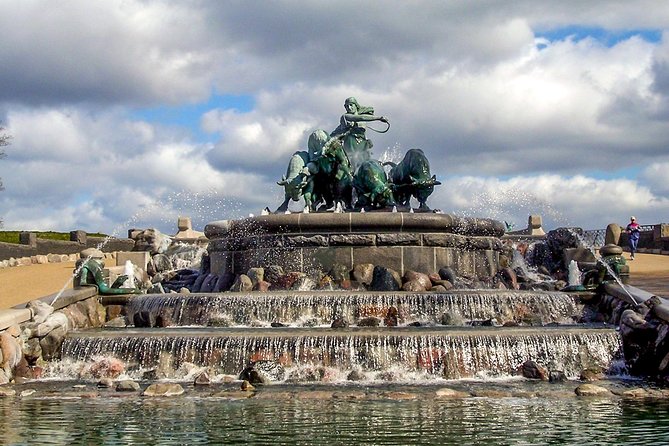
The walk continues toward Kastellet, the star-shaped fortress built in 1664. Its unusual form makes it one of the most memorable sights on the route. Even without an extended visit, the guide can explain how the fortress was designed and why its shape looks so different from an ordinary city building.
You’ll also hear the legend of the Norse goddess Gefion, whose story is represented in the impressive Gefion Fountain. This is the kind of short cultural story that helps a landmark stick in your mind. Instead of seeing a large fountain as just another photo stop, you have a myth to attach to it.
The timing is both a strength and a limit. A quick look at Kastellet gives you a useful introduction, but it does not leave room for a full walk around the fortress grounds. If the fortress is one of your main interests, plan to return later with more time.
That is a recurring theme on this experience. The guide helps you identify places worth a longer visit, but the 90-minute route cannot give each major sight the attention it deserves.
The Marble Church and a Kierkegaard statue
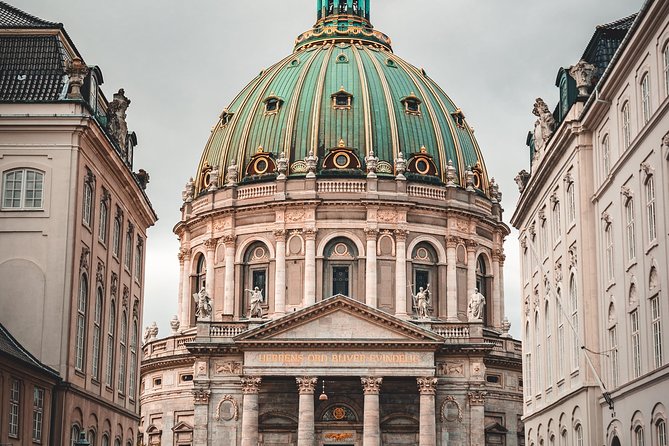
Another highlight is the Rococo church known for having the largest dome in Scandinavia. The tour also points out a statue of Søren Kierkegaard in the grounds.
Together, these details create a strong art and culture pairing. The church offers grand architecture, while the statue brings in Danish philosophy and literature. You get two very different ways to think about the country’s cultural life in one stop.
The supplied information refers to the structure by its design and dome rather than promising entry, so plan on seeing it from outside. That is still worthwhile, particularly if the guide explains the church’s scale and Rococo character, but you should not book this walk expecting a church interior visit.
The Kierkegaard statue is the sort of detail that makes a guided walk useful. You might notice the building on your own, but a guide can direct your attention to the person represented nearby and explain why that figure belongs in the city’s cultural story.
Palace gardens with the Royal Opera House across the water

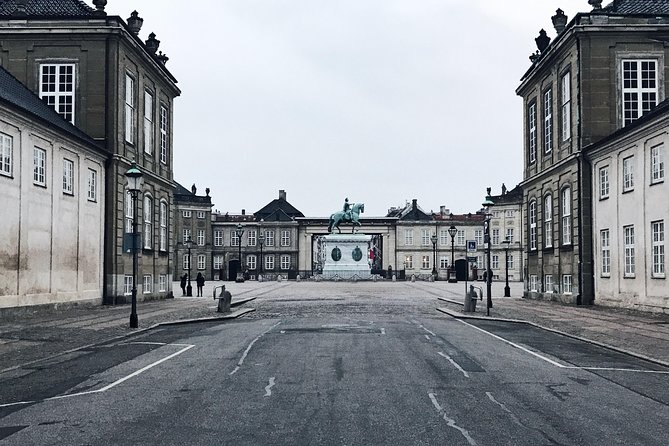
The route then reaches an imposing square, a palace, and a garden. From here, you can look across the water toward the Danish Royal Opera House.
This is one of the route’s best visual combinations. You have formal royal surroundings on one side and a modern cultural building on the other. The view lets you consider Copenhagen as both an old capital and a living city with active arts institutions.
The guide can provide context as you take in the square and palace grounds, but the details provided do not indicate an interior palace visit or a performance at the Opera House. You are seeing the setting and the relationship between the buildings, not attending a show.
The route’s use of views is important because it keeps the experience varied. You are not simply stopping at one monument after another. Gardens, water, architecture, and open squares break up the walking and give you different ways to read the city.
One practical point: the route is described as a guided walk, so comfortable footwear is sensible. The total distance is not provided, but the experience moves through several central areas in a limited time. You should be prepared to keep moving rather than linger at every stop.
Finishing among Nyhavn’s colorful facades
The walk ends at Nyhavn, the picturesque 17th-century harbor lined with colorful waterfront facades. This is a satisfying finish because the harbor gives you an instantly recognizable Copenhagen scene and leaves you in a useful central location for further exploring.
The end point also makes the tour easy to build into a larger day. Afterward, you can continue looking around Nyhavn or use nearby public transportation, since the starting point and route are close to central transport links. The experience does not include a meal or drinks, so any harbor-side refreshment is your own expense.
Nyhavn is photogenic, but it is also a place where a short visit can become crowded or costly if you sit down without checking prices. The guide can explain the setting and its past, while you decide how long to stay afterward.
Ending here gives the walk a clear shape. You begin in an old town square and finish beside the water, with royal architecture, public art, a fortress, gardens, and a major church in between.
How much detail will you receive?
The tour promises local stories rather than a fixed academic lecture. You can expect information about Copenhagen’s sights, street art, museums, galleries, and Danish food customs. The food material may be especially useful because it adds daily life to a route that could otherwise focus only on monuments.
At the same time, the amount of detail may vary. One assessment of the experience found that it covered many historical points with appealing small facts, including food customs, but wanted more explanation in places. That is fair criticism for a 90-minute walk covering so many stops.
You may also encounter quiet stretches between sights. If you prefer nonstop commentary, this could feel underfilled. If you like time to look around and take photographs, those pauses may be welcome.
The best way to improve the experience is to arrive with two or three questions. Ask about a piece of street art, the fortress, Danish eating habits, or a building you pass. A small group gives you a better chance to shape the conversation than a large guided crowd.
The route’s art focus has limits
The title suggests a broad look at art and culture, and the walk does include street art, sculpture, architecture, literature, philosophy, and public spaces. But you should not confuse that with a full museum and gallery visit.
The route may pass near cultural institutions or inspire ideas for later visits, but the stated stops do not include admission to an art museum, gallery, palace, or church. One useful criticism of the route is that a slight detour might have allowed a glimpse of the art museum and King’s Theatre. Those locations are not guaranteed parts of the walk, so do not book it specifically for them.
I see the art focus as a bonus rather than the entire purpose. The real strength is the combination of modern street art and major public landmarks. If you want close study of paintings, a specialist art guide, or time inside collections, you need a different experience.
Group size, access, and cancellation
The group has a maximum of eight people. That is a meaningful advantage at this price because you should have a better chance to hear the guide and ask questions without competing with a large crowd.
The tour is offered in English and uses a mobile ticket. Confirmation is provided when you book. The meeting point is near public transportation, and service animals are allowed. Most people can participate, but no detailed accessibility information is provided, so you should contact the provider if you need specific guidance about walking conditions or route access.
The experience offers free cancellation if you cancel at least 24 hours before the start time. Cancellations made less than 24 hours in advance are not refunded, and changes within that period are not accepted. Cut-off times follow local Copenhagen time.
Who will get the most from this walk?
I would recommend it most strongly to:
- First-time visitors who want a quick introduction before exploring Copenhagen alone.
- Returning visitors who want local stories and a different view of familiar central sights.
- Art and architecture fans who enjoy seeing street art alongside churches, palaces, sculptures, and public squares.
- Small groups who value a compact format and may benefit from group discounts.
- Independent-minded visitors who want suggestions for what to return to later.
I would be more cautious if you want a long, detailed history lesson or guaranteed access to museums and buildings. The route covers many sights quickly, and its success depends partly on how much detail your particular guide adds.
Should you book Explore Copenhagen’s Art and Culture with a Local?
Book it if you want a short, broad orientation to central Copenhagen with a local guide and a group capped at eight. The combination of Stine Hvid’s street art, Kastellet, the Gefion legend, the Marble Church, palace gardens, and Nyhavn gives you a useful first map of the city’s cultural sights.
At $128.94 per person, the tour needs to deliver more than a basic landmark checklist to feel worthwhile. The local stories, Danish food customs, and small-group format help justify the price, but you should not expect a museum tour or a deep study of each stop.
My advice is to book this near the start of your stay, then use the guide’s suggestions to decide where to return. If you have only 90 minutes and want a friendly introduction, it is a sensible choice. If you have plenty of time and prefer to explore at your own pace, save the money and walk these central sights independently.
FAQ
How long does the Copenhagen art and culture tour last?
The experience lasts approximately one hour and 30 minutes.
Where does the tour begin?
The tour begins at Stork Fountain, Amagertorv 6, 1160 København, Denmark.
Where does the tour end?
The walk ends at Nyhavn in Copenhagen’s Indre By area.
Is the tour offered in English?
Yes. The experience is offered in English.
How many people can join the tour?
The group has a maximum of eight travelers.
Are food, drinks, and attraction admissions included?
No. Personal expenses, food, drinks, snacks, and attraction admissions are not included.
Just added around Copenhagen
- Urban Design and Livability E-bike Tour★ 4.8 · 21 reviews
- Full-Day Tour; Castle, Palace & Cathedral, Winter(JAN-MAR)★ 5.0 · 11 reviews
- a day at North Zealand Castle Tour★ 4.5 · 19 reviews
- The Philosopher’s Last Walk: An audio tour on the life of Søren Kierkegaard★ 4.5 · 5 reviews
- The Six Forgotten Giants Trolls Hunt with Minibus★ 4.5 · 27 reviews
- Copenhagen Walking Tour with Food Testing (smorrebrod dish & snap)★ 4.5 · 10 reviews
- The Forgotten Giants Private Tour★ 5.0 · 3 reviews
- Explore the Instaworthy Spots of Copenhagen with a Local★ 3.5 · 3 reviews
Copenhagen Tours, compared.
Copenhagen Card-Discover: 80+ Attractions & Public Transport
Read our review →
Hop-On Hop-Off Bus Tour with Boat Tour Option
Read our review →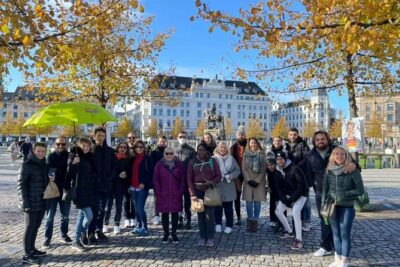
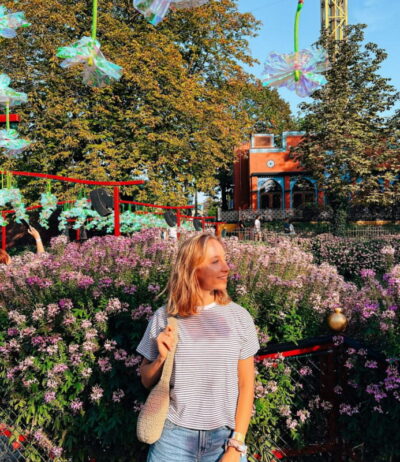
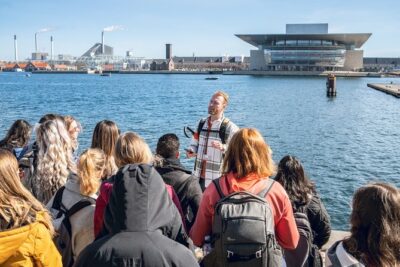
Highlights 3 Hour Bike Tour with a Local Guide
Read our review →
Hamlet and Sweden Tour – Two Countries in one day !
Read our review →
Browse the lists this tour appears in